How Can We Help?
-
Controllers
-
- Pro-160 / 360 Fault Codes
- Pro-160 / 360 Temperature Sensors
- Pro-100 / 160 / 360 to Hall Throttle Wiring
- JSK-120 Driving Two Pro-360s
- RBT and Pro-160 / 360 P3 Pot Fault
- Pro-160 / 360 Dual Control
- Pro-100 / 160 / 360 Radio Control Failsafe
- Pro-100 / 160 / 360 to JSK-100 wiring
- Pro-100 / 160 / 360 Failsafe Contactor
- Double Heading the Pro-100 / 160 / 360
- Pro-160 Layout Diagrams
- Pro-100 / 160 / 360 Software Versions
- Use with shunt wound motors
- Use with Series Wound Motors
- Updating Firmware
- Double Heading Pro-160 / 360 & 4QD Series
- Push Button Mode With Limit Switches.
- Pro-100 / 160 / 360 Troubleshooting
- Speed Sensor Ratio
- Push Button - Forward / Off / Reverse Operation
- Show Remaining Articles (5) Collapse Articles
-
- Pro-160 / 360 Fault Codes
- Pro-160 / 360 Temperature Sensors
- Pro-360 Heatsink Removal and Replacement
- Pro-100 / 160 / 360 to Hall Throttle Wiring
- JSK-120 Driving Two Pro-360s
- RBT and Pro-160 / 360 P3 Pot Fault
- Pro-160 / 360 Dual Control
- Pro-100 / 160 / 360 Radio Control Failsafe
- Pro-100 / 160 / 360 to JSK-100 wiring
- Pro-100 / 160 / 360 Failsafe Contactor
- Double Heading the Pro-100 / 160 / 360
- Pro-100 / 160 / 360 Software Versions
- Updating Firmware
- Use with shunt wound motors
- Use with Series Wound Motors
- Double Heading Pro-160 / 360 & 4QD Series
- Push Button Mode With Limit Switches.
- Pro-100 / 160 / 360 Troubleshooting
- Pro-360 Locknut Service Bulletin
- Speed Sensor Ratio
- Push Button - Forward / Off / Reverse Operation
- Show Remaining Articles (6) Collapse Articles
-
- Pro-100 Fault Codes
- Pro-100 / 160 / 360 to Hall Throttle Wiring
- RBT and Pro-160 / 360 P3 Pot Fault
- Pro-160 / 360 Dual Control
- Pro-100 / 160 / 360 Radio Control Failsafe
- Pro-100 / 160 / 360 to JSK-100 wiring
- Pro-100 / 160 / 360 Failsafe Contactor
- Double Heading the Pro-100 / 160 / 360
- Pro-100 / 160 / 360 Software Versions
- Updating Firmware
- Use with shunt wound motors
- Use with Series Wound Motors
- Pro-100 / 160 / 360 Troubleshooting
- Speed Sensor Ratio
- Push Button - Forward / Off / Reverse Operation
-
- Mosfet Insulator Arrangement DNO & Porter
- How To Wire Up a Porter 5
- Closed Loop Current Control
- Fitting a Porter to a PDQ Power trike
- Driving the Porter by Raspberry Pi
- Porter: Disabling Regenerative Braking
- Porter Current Limit Adjustment
- DMR-203 Radio Control of a Porter 5 / 10
- Porter 40 Speed Controller
- Porter 40: Use with PWM Input
- Porter Troubleshooting
-
-
- PRO-150 Overview
- Double Heading for the Pro-150 and 4QD Series
- Pro-150 Hall Throttle Supply
- Pro-150 Hall Throttle Programming
- Pro-150 Push Button Use
- Use with shunt wound motors
- Pro-150 Fault Finding Guide
- Pro-150 Pt Fault Code
- Pro-150 programmable parameters
- Pro-150 Mechanical Information
- Pro-150 Basic Wiring Diagram
- Fraser Golf Buggies, Wiring for Pro-150
- DMR-203: Use with PRO-150 Controllers
- Pro-150 Capacitor Modification
- PRO-150 Current Limit
- PRO-150 Issue History
- PRO-150 Joystick Programming
- Show Remaining Articles (2) Collapse Articles
-
- 4QD-200/300 Overview
- Double Heading for the Pro-150 and 4QD Series
- Control Board Jumper Positions
- Ampflow motor
- Damage From Blown Mosfets
- DMR-203: Use with 4QD Series Controllers
- Battery Contactor for 4QD-200 / 300
- Adjustment for 48V
- Inhibit switch / footbrake - 4QD series only [tour 16]
- Forward / Off / Reverse Mode (4QD Series)
- Converting Parking Brake to Brake Light
- Disabling HPLO on Early 4QD Models
- Inhibit Ramp Modification [4QD series]
- Over voltage protection in the 4QD series
- Deadband values and removal
- How to dismantle the 4QD series
- Fault finding on the 4QD series
- Testing the 4QD Base Board and MOSFETs
- Reverse Acceptance Threshold [RAT] Modification
- Current limit resistors
- Use with Tacho Feedback Board
- Control Board Modification [Pre June 2010]
- Reverse Speed Modification [pre issue 17]
- Reversing Latch Modification [pre issue 16]
- Damage from a Reversed Battery (4QD Series)
- Mixing 4QD 150 / 200 / 300 series boards
- 4QD version history
- Inhibit
- Show Remaining Articles (13) Collapse Articles
-
- Damage from Reversed Batteries (NCC/VTX)
- Waveforms and Fault Finding
- Ramp Timings (NCC)
- Internal Power Supply and Protection Circuitry
- Fitting Expansion Connector
- NCC Speed Controller
- VTX and NCC Operating Voltages
- NCC Circuit Description
- VTX / NCC Fault Finding
- NCC Mark 2 Issue Number History
- NCC Mark 1 Issue Number History
- NCC Key Components
- NCC Zener Diode Failure
-
- Internal Power Supply and Protection Circuitry
- Current Limiting in the Pro-120 [and others]
- Pro-120 Mk1 History
- Pro-120 Mk2 History
- Pro-120 Key Components
- Earth Fuses: Why Do They Blow?
- Modifying the Pro-120 for other voltages
- Pro-120 Fault Finding Tips
- PRO-120: Multiple Slaves
- PRO-120 Ramp Reduction
- Fitting Expansion Connector
- Pro-120 Modification to give Uni-Directional Control
- Pro-120 Robot Wars Version
- Pro-120 Ignition Options
- Battery Discharge Protection: PRO-120
- Pro 120 Mark 1 Speed Controller
- PRO 120 Mark 1 - Additional Diagrams
- Show Remaining Articles (2) Collapse Articles
-
-
-
Accessories
-
-
- Articles coming soon
-
- Articles coming soon
-
- Articles coming soon
-
- Articles coming soon
-
- Articles coming soon
-
- Articles coming soon
-
Application Notes
-
- Alternative Double Heading [MU] Solution
- Double Ended Tram Control
- Loco Wiring: Auto Reversing Lights
- Speed to RPM Calculator
- Noise Suppression for Multiple Motors
- DCC / Airwire Interface
- Phoenix Loco Wiring
- Loco Wiring: Hand Control & Horn Relay Board
- Double Heading Problems
- Motors in Parallel
- Basic Model Loco Installation [with RBT and HRB]
- Low Pulling Power
- Radio Control
-
-
-
Technical
-
- Speed to RPM Calculator
- Noise Suppression for Multiple Motors
- Improving Heat Dissipation
- A Basic Installation
- Motor Noise Suppression
- Catching diodes
- Multi speed control
- Parking Brakes in Series
- Fuses and Circuit Breakers
- Radio Control Wiring Hints
- Typical Wiring for the PRO-150, DNO, VTX and NCC Controllers
- Wiring for Hand Control and Radio Control
- Wiring for Push Button Use
- Good Wiring Practise
- Motors in Parallel
- Push Button Mode With Limit Switches.
- Forward / off / reverse mode or push-button operation
- Basic Model Loco Installation [with RBT and HRB]
- Pro-100 / 160 / 360 to Hall Throttle Wiring
- How do I select the parts?
- Use With Switch Mode Power Supplies
- Push Button - Forward / Off / Reverse Operation
- Wiring for Curtis ET-126MCU
- Radio Control
- DIN Socket Wiring
- Show Remaining Articles (10) Collapse Articles
-
- Current limit
- PCB numbers
- Acceleration and Deceleration Ramps
- Thermal shutdown
- Ignition
- Power down state
- Ramps
- Reversing
- Overvoltage protection
- Battery Discharge Protection
- Joystick [aka wig-wag]
- Parking brake driver
- Pot Fault Detection
- High Pot Lockout HPLO
- Reverse polarity protection [tour 26]
- Main Capacitor
- Radio control interface
- Tacho Generator Feedback
- Voltage Following
- What Does a Motor Speed Controller Do?
- Ignition Circuit
- Coulomb Counting
- Show Remaining Articles (7) Collapse Articles
-
- Using a BMS with a Motor Controller
- Mosfet Alternatives
- Testing an Electric Motor
- What is EMC [Electromagnetic Compatibility]?
- Closed Loop Current Control
- Battery Current and Motor Current
- MOSFETs
- Half bridge
- Switching frequency
- What is Regenerative Braking?
- Batteries
- Customised Arc Potentiometers
- What is PWM Motor Control
- Full Bridge
- Towing
- Torque
- Surge Currents
- Speed Stability
- Quadrants
- Heat
- Thermal shutdown
- Heatsinking
- Choosing a Controller
- Earth Track Fuse and Earth Loops
- Tacho Set-Up
- Charging a 24V Battery From a 12V Source
- What Voltage Should I Use? [12, 24, 36, or 48V]
- Positional Servo Control [DNO / VTX]
- POT Dead Band
- Why Do Mosfets Fail?
- Back EMF & Internal Resistance
- Use of Generators with Speed Controllers
- Control by Microprocessor
- Foot Pedal Idea
- Coulomb Counting
- Low Pulling Power
- Curtis Equivalents
- Show Remaining Articles (22) Collapse Articles
-
Mobility Scooters
Mobility scooters generally operate at 24v and have a legal top speed of 4 mph on the pavement, road vehicles can have a top speed of 8 mph. 4QD controllers can be wired with a ‘top speed switch’ to restrict speed to either 4 or 8 mph.
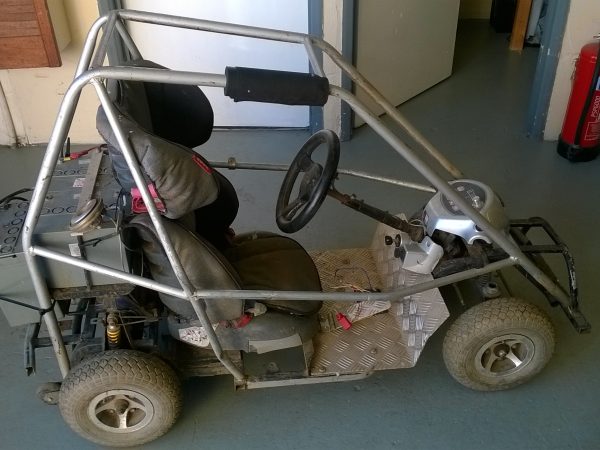
4QD controllers have been used as replacements for broken oem controllers, or when re-purposing an old scooter or motor for some other application. As always the choice depends on the motor current and the application but it usually comes down to a choice between the DNO-10, Pro-160, or Pro-360 [in increasing capacity].
A common motor for mobility scooters is the EMD PM50 (about 250w rating), up hills and kerbs this can draw up to 50 amps peak, although it will draw less on the level. It is quite common to see two motors used, one on each rear wheel.
Controllers for mobility scooters have become complex and sophisticated, in part this is because the earliest vehicles were designed for people with limited control, the controllers therefore became very sophisticated to cope with the user’s disabilities. The second reason for this complexity is that early power semiconductors were temperamental and unreliable, so designs added more and more fail-safe protection circuitry. 4QD’s controllers started life for the golf industry, which has started from the other end – very low technology gradually improving with time but always very price conscious. Golf vehicles need 100 to 200 amps which is much more than most mobility scooters.
The DNO-10, Pro-160, or Pro-360 all have fail safe mechanisms built in and an uncontrolled failure to high speed is extremely unlikely. Even so, for passenger carrying vehicles we always recommend fitting a battery contactor or isolator switch within easy reach of the driver.